TL;DR
- Airbyte took its Cloud service offline on November 17 after what it called a security incident that it believes is "part of a broader, global cyberattack." It says fewer than 1% of customers were affected and that it contacted each of them directly.
- Nearly four days later, 16 API connectors, including Salesforce, HubSpot, Jira and three Zendesk products, were still down "due to OAuth being deactivated," and the Connector Builder and Airbyte's MCP endpoint stayed offline as "a cautionary measure." A second update that morning, still the newest when we checked on November 23, listed 15.
- The 1% figure counts customers Airbyte says were affected. The outage shows something else: how many customers share the same keys. In an integration platform those are different numbers, and the second one is the one to plan around.
For the data teams that run on Airbyte Cloud, Tuesday, November 17 started as an ordinary bad morning. Around 11 a.m. GMT, by one customer's account, the trouble started. Airbyte's status page opened an incident at 11:22 UTC, and by early afternoon users trying to reach the web app or the API were getting a page that read "Airbyte is temporarily unavailable (HTTP 502)." Pipelines that pull Salesforce data into a warehouse, or push data back into HubSpot, stopped.
About ten hours in, the explanation changed category. Airbyte said it had identified a security incident that it believed was "part of a broader, global cyberattack." Fewer than 1% of its customers were affected, the company said, and it had already contacted each of them directly. Its security team had detected the attack, blocked it and taken Airbyte Cloud offline, "preventing the attacker from maintaining access to our systems." Cloud would stay dark until the company was confident it was safe to bring it back.
Then the sentence moved. Andrew Jones, who writes a newsletter about data engineering and whose own team chose Airbyte Cloud, noted on November 20 that Airbyte had removed the cyberattack wording from its status page, though the statement remained on the company's X account. When we read the incident page on November 23, the words "security incident" and "cyberattack" no longer appeared anywhere on it.
Six days on, the number that has traveled furthest is the reassuring one: fewer than 1%. It frames the event the way most vendor incidents get framed, as a small breach with a large outage bolted on, and it invites everyone outside the 1% to file the week under downtime. That frame gets the arithmetic of integration platforms wrong. The 1% and the outage are measured in different units. One counts customers whose data an attacker may have touched. The other counts customers who share the same keys. What follows explains those keys, why switching them off has to hit everyone at once, why the outage is the good version of this story, and what the parts still offline, a connector builder and an endpoint for AI agents, say about where integration risk is heading.
Six days, in the order things went dark
Airbyte has not published a root cause. Its status page is the only running record, and it reads like a recovery in layers, each one telling you something about how the platform is built.
At 03:08 UTC on November 19, about 40 hours after the first update, Airbyte said it was "gradually returning services to Airbyte Cloud, starting with backend syncs for some customers." By 08:05 UTC on November 20, "most data syncs" were operational, but "API sources are unavailable," while "database connectors are functional." Single sign-on, the Connector Builder and the MCP endpoint were all still down.
Early on November 21 the page got specific. At 04:05 UTC Airbyte wrote that "16 API Connectors remain down due to OAuth being deactivated," and listed them: Salesforce as both a source and a destination, HubSpot as both a source and a destination, Gong, Harvest, Intercom, Jira, Mailchimp, Retently, Snapchat Marketing, Trello, Uptick, Zendesk Support, Zendesk Sunshine and Zendesk Talk. "Builder and MCP remain down until we feel confident that these are safe to bring back online," the update said. "This is a cautionary measure." It closed with a line that matters for anyone restarting pipelines: "It is safe to update your connectors and re-enable your syncs." Two hours later Intercom came back, leaving 15.
That was still the newest update when we checked on November 23. Notice the order. Database connectors, which typically authenticate with a username and password the customer created and pasted in, came back first. The connectors that stayed down are the ones that log in to a SaaS application through OAuth. The sixteen are not every SaaS connector, though. The status page lists other SaaS sources, among them Slack, GitHub, Shopify and Stripe, as operational, and Airbyte has not explained why these sixteen were singled out.
A pipeline outage is loud on day one and quiet by day five. Dashboards keep rendering last Monday's numbers without complaint, and as a German hotel learned this month, a missing signal tends to look like an all-clear. Alerts on data freshness, not only on failed runs, are what catch the long tail of an outage like this one.
The database connectors came back first. The ones that borrow someone else's login stayed down.
What an integration platform is actually holding
Start with the literal mechanism, because it explains the order of the recovery. When you connect Salesforce to Airbyte Cloud, Airbyte's documentation tells you to click "Authenticate your account," and the option is labelled the Airbyte Connected App. That is OAuth 2.0's authorization code flow. Salesforce shows you a consent screen for an application that Airbyte registered with Salesforce, you approve it, and Salesforce issues Airbyte a refresh token for your org. HubSpot works the same way in Airbyte Cloud, through a sign-in popup, and Airbyte's docs say they "highly recommend" that path over pasting in a private app token.
Two different credentials now matter, and they belong to different people. The refresh token is yours, in the sense that it was minted for your connection and carries the permissions of whoever clicked approve. It is long-lived, and Airbyte relies on it whenever a sync runs, because API sources work by calling the provider on a schedule, the pull side of the trade-off we laid out in event-driven versus polling. The client credentials are Airbyte's: one client ID and one client secret that identify Airbyte's application to Salesforce, shared by every customer who clicked the same button.
The OAuth 2.0 specification, RFC 6749, ties the two together on purpose. "Because refresh tokens are typically long-lasting credentials used to request additional access tokens," it says, "the refresh token is bound to the client to which it was issued." A confidential client such as a server-side platform "MUST authenticate with the authorization server" when it uses one. By design, your token is only supposed to work alongside Airbyte's own credentials.
Self-managed Airbyte flips the ownership. For HubSpot, the docs recommend a private app access token that you create inside your own HubSpot account. For new Salesforce setups, they point to a client credentials method that uses an app you register in your own org. Either way, the application identity belongs to you, and so does the switch that turns it off.
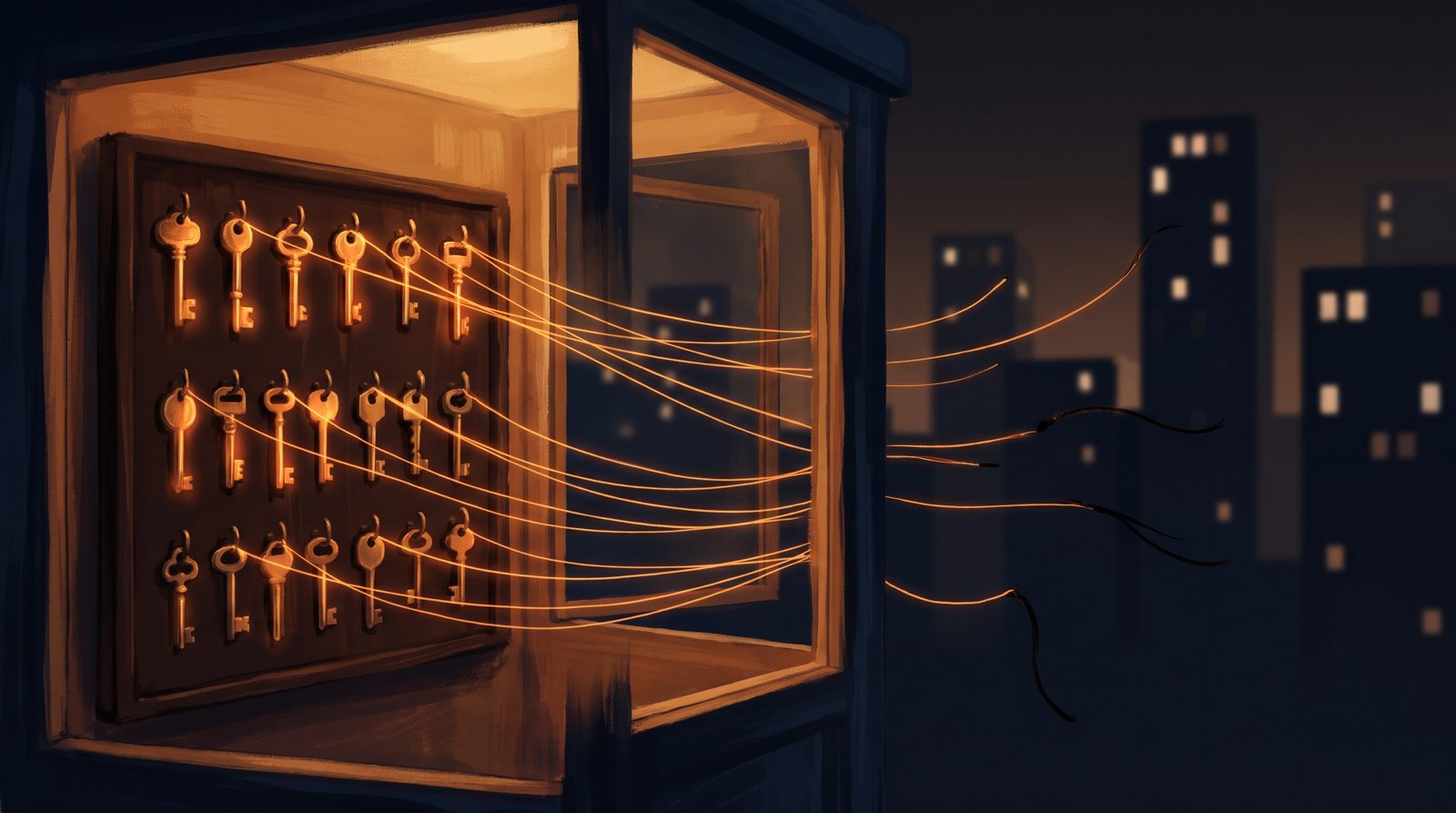
Here is the picture worth carrying through the rest of this piece. Airbyte Cloud works a bit like a valet stand outside a busy restaurant. Each driver hands over a key, and every key hangs on one board inside one booth. The keys are individual. The booth is shared. If someone gets into the booth, the valet company cannot know which keys were copied, so every driver has to assume theirs might have been. And the parking garage, which in this picture is Salesforce or HubSpot, can do something no single driver can do: ban the valet company outright, which strands every car it ever parked.
The comparison is useful, but it undersells one thing. A copied car key starts the car. A stolen refresh token, on its own, should not work for a confidential client, because the provider also demands the platform's client secret. That sounds like a second lock, and it is one. On an integration platform, though, both locks usually sit inside the same production systems, because the platform needs both of them whenever it refreshes an access token. The second lock stops a thief who walked off with one database table. It does much less against a thief who got into the booth.
Your token is yours. The trust it rides on is pooled.
The turn: the 1% and the outage measure different things
Airbyte's figure, fewer than 1% of customers affected, is the company's own count, and nobody outside Airbyte can check it yet. There is no particular reason to doubt it. But look at what it measures: the customers Airbyte's investigation counts as affected, which in incident language usually means those whose data or accounts the attacker actually touched. It does not tell you what would have been within reach had the attacker kept access, and that second number is the one that decides what containment has to look like.
"OAuth being deactivated" makes the point mechanically. The status page does not say whether Airbyte switched off its own app registrations or whether the providers did it, and Airbyte has not said why. The effect is the same either way. Every customer connection that rode on that application stopped at the same moment, the 99% along with the 1%. You can revoke one customer's token. You cannot switch off an application for only some of the people who use it.
That is the first half of the turn. The second half is the part almost nobody says out loud: for the 99%, the outage is what the good version of this story looks like.
Line up the precedents by how long the stolen keys kept working. When attackers abused OAuth tokens from the Salesloft Drift chat integration in 2025, Google's threat intelligence group found the activity began "as early as Aug. 8" and ran "through at least Aug. 18." Salesloft and Salesforce revoked all active access and refresh tokens for the Drift application on August 20. In Heroku's 2022 incident, by Heroku's own account, an attacker downloaded customers' stored GitHub integration tokens on April 7. GitHub told Heroku on April 13, and Heroku revoked every existing GitHub integration token around April 15. At CircleCI, the attacker exfiltrated data on December 22, 2022, and CircleCI began rotating customers' GitHub OAuth tokens on December 31.
Airbyte says it detected the attack, blocked it and went offline. If that holds, the platform pulled the plug while the intrusion was still live, instead of learning about it from a third party a week later. The caveat is real and worth stating flatly: this comparison rests entirely on Airbyte's own account of its detection, and attackers' first access is often discovered well after the date a company first notices them. Even so, the shape is right. A platform that stays up through a breach has not necessarily protected you better. It may only have noticed later.
The outage you sat through was not collateral damage. It was what the shared keys cost to secure.
Four integrations, one shape
None of this is new, which is the most useful thing about it. The same structure has failed in public at least four times since 2022, and each time the details rhymed.
In April 2022, GitHub's chief security officer, Mike Hanley, disclosed that an attacker had used "OAuth user tokens issued to two third-party OAuth integrators, Heroku and Travis-CI," to download data from dozens of organizations, including npm. GitHub's first clue was a compromised AWS API key used against npm's production infrastructure, a key the attacker had likely obtained by downloading private npm repositories with a stolen token. Heroku's own review, published that June by general manager Bob Wise, said the attacker had reached a Heroku database and downloaded the stored tokens. Heroku took its first containment step "within three hours" of GitHub's warning, then revoked every existing GitHub integration token and blocked new ones, which cut off the integration for every customer. Its write-up admitted the disruption that caused and called it "a critical step to protect your data."
In January 2023, CircleCI's chief technology officer, Rob Zuber, described how malware on one engineer's laptop stole "a valid, 2FA-backed SSO session." The attacker took customer environment variables, tokens and keys, and although they were encrypted at rest, the attacker "extracted encryption keys from a running process." CircleCI rotated GitHub OAuth tokens on its customers' behalf and told every customer to rotate every secret, "including OAuth tokens, Project API Tokens, SSH keys, and more."
In August 2025, Google's threat intelligence group traced the Salesloft Drift campaign to an actor it tracks as UNC6395, which used stolen OAuth tokens to export large volumes of data from corporate Salesforce instances while hunting for AWS access keys, passwords and Snowflake tokens. Salesforce pulled Drift from its AppExchange. Salesloft's early scoping, as Google relayed it, said customers who did not integrate with Salesforce were not affected. On August 28, Google's update superseded it: tokens for a "Drift Email" integration had been compromised too, and had been used to read mail in "a very small number" of Google Workspace accounts. Google's guidance was blunt: "treat any and all authentication tokens stored in or connected to the Drift platform as potentially compromised."
The fourth case is barely two weeks old. On November 9, researchers at Wiz, working with Sentra and Mandiant, reported that a threat actor had used IAM credentials from the AWS account of Qubole, a cloud data platform, to assume integration roles inside its customers' AWS accounts between October 14 and 26. Every one of those requests carried the correct External ID, the value that is supposed to stop strangers from borrowing a vendor's trust, and every one succeeded. The attacker enumerated storage, pulled secrets from Secrets Manager, Parameter Store and Lambda configurations, and in some sessions downloaded entire buckets. Wiz added in an update, citing Risky Business, that a group calling itself n0n had claimed the intrusion. On November 19, JPMorganChase, Visa and Mastercard each disclosed incidents at third-party vendors without naming them, and AppOmni noted the next day that a link to Qubole remains unconfirmed.
Earlier this month, the mobile CI service Bitrise also switched its platform off, after an intruder came in through an internal testing bot account that had no second factor. Different door, same instinct: when the shared machinery is in doubt, everyone stops.
Read in order, these cases share a pattern that should shape how the Airbyte number is read. The first scoping statement is a starting estimate. In the Drift case it grew. None of that means Airbyte's figure will move. It means the industry's own record says to plan as though it might.
Inside the key cabinet: what an integration platform holds for you
- App registrations. One client ID and secret per provider, shared by every customer who connected through the platform's app. Switching one off stops every connection built on it.
- Refresh tokens. One per customer connection, carrying the permissions of the person who approved it. These can be revoked one by one, at the provider.
- Pasted credentials. API keys, database passwords, private app tokens. The platform can delete its copy, but only you can make the old value stop working.
- Cloud trust relationships. Cross-account roles that let the vendor's cloud account act inside yours. Rotating secrets does not touch them; they last until you delete the trust policy.
- Code paths. A connector builder turns a customer's definition into requests that run on the platform's machines, near everything listed above.
- Agent endpoints. An MCP server lets AI agents reuse connections that people already approved, without necessarily asking those people again.
Why the builder and the agent door stayed shut
The two components Airbyte is keeping offline longest are worth a closer look, because they are the two that look least like a pipe.
The Connector Builder is Airbyte's no-code tool for making a new source connector. You describe an API in the interface, Airbyte writes a declarative YAML manifest behind the scenes, and you can test reads against the real API before saving. On October 17, Airbyte published a critical advisory for its self-managed product, rated 9.9 out of 10, titled "Remote code execution via Connector Builder custom components when unsafe code is disabled." Before version 2.2.0, the Builder and its Manifest Server "did not restrict which Python classes a declarative manifest could reference as a custom component," so a user who could submit a manifest for a test read could run commands inside the container, with access to whatever data, credentials and internal services that container could reach. On November 4, Japan's JVN vulnerability database, coordinated by JPCERT/CC, published its own advisory and stated that exploitation "has been confirmed." JVN credits Takeyasu Hyodo of ZOZO, Inc. with reporting it.
Nothing public connects that flaw to the Cloud incident, and the October advisory told Airbyte Cloud customers they did not need to take any action. It is still the clearest illustration of why a connector builder is a sensitive component in principle. It is the one part of an integration platform designed to accept a definition from a user and execute it on the platform's own machines, a short hop from the key cabinet. Keeping it dark until the investigation is finished is the obvious call.
The MCP endpoint is the newer door. Airbyte's documentation now describes the product as "an open source data replication platform and context layer for AI agents," able to "equip your agents to query, search, and act on your data in real time." An MCP server is one way that promise reaches an agent: the agent calls a tool, and the platform can answer using connections that a human approved weeks earlier. We made a related point when GitHub added connectors to Copilot, that "verified" describes the pipe, not the permissions. The same logic applies here. A platform that hands stored connections to event-driven AI agents has added a second front door to the same booth, and that door is built to be used by software, at software speed.
Airbyte has not said why it considers these two components riskier than the rest, and it would be speculation to guess. The pattern it chose is legible anyway: the parts that execute other people's instructions stay off longest.
The pipes came back first. The parts that run someone else's instructions are still dark.
Moving the stand in-house is not a clean exit
Andrew Jones's response is the one many teams are weighing this week. "Every SaaS vendor is a much more attractive target than you are," he wrote. "A data integration platform like Airbyte holds credentials for your most critical systems. That's a honeypot." His conclusion: "In the meantime we'll be moving to self-hosted Airbyte as we've lost confidence in their cloud product." He noted that the product being open source, with self-hosting as a fallback, was one of the reasons his team picked Airbyte Cloud in the first place.
The argument for leaving is real, and it follows directly from the valet picture. Self-hosting gets your keys off a board shared with every other Cloud customer. You register your own OAuth app or create your own private app token, you hold the only switch that turns it off, and a breach elsewhere no longer forces a shutdown on you. Your blast radius shrinks to one organization: yours.
The argument against is sitting in the same advisory. The October Connector Builder flaw was a self-managed problem; Cloud customers were told to do nothing. On Airbyte 2.x before 2.2.0, exploiting it required an account with reader access. On Airbyte 1.x deployed with the legacy Helm chart, the Connector Builder service "did not inherit" the global authentication setting, which meant any client with network access could reach it without logging in. The advisory states that "Airbyte 1.x will not receive a fix." We wrote this weekend about authentication that ships switched off in a medical imaging tool and how long the fix took to reach users. The Airbyte case has the same shape, with one twist: the most exposed self-hosted users were the ones who never upgraded.
Self-hosting, then, is a trade, not an escape. You leave a shared booth that a vendor's security team watches, and you take on a booth of your own that you must guard, patch and monitor. For a team with a real platform group, that can be the better deal. For a two-person data team, it may only move the honeypot somewhere with fewer guards.
The numbers, and what they cannot tell you
The figures around this incident are real, but they come from different places and measure different things, so it helps to keep them apart.
Fewer than 1%. This is Airbyte's own count of affected customers. The company has not published the denominator, so the figure cannot be turned into a number of organizations, and it describes reach, not exposure.
Sixteen, then fifteen. The connector count looks larger than the list of services, because Salesforce and HubSpot each appear twice, once as a source and once as a destination. Sixteen entries cover fourteen services. Those destination entries matter: for some customers, Airbyte does not only read from Salesforce and HubSpot, it writes into them.
About 40 hours. That is the gap between the first status update at 11:22 UTC on November 17 and the first syncs returning at 03:08 UTC on November 19. Full recovery of the OAuth connectors had not been announced six days after the start.
9.9, 8.8 and 8.7. The same Connector Builder flaw carries three severity scores: 9.9 from Airbyte's GitHub advisory under CVSS 3.1, and 8.8 and 8.7 from JVN under CVSS 3.0 and 4.0. The gap comes mostly from whether a scorer believes the flaw lets an attacker reach beyond the container. It is a reminder that a severity number describes a bug in the abstract, not your deployment of it.
Thirteen days. In the Qubole case, the role assumptions Wiz documented ran from October 14 to 26, and the public write-up arrived on November 9. In the Drift case, the activity window ran at least ten days before tokens were revoked.
What these numbers cannot tell you is the one that matters most to an individual team: whether your own tokens were among the ones the attacker saw. Airbyte says it has contacted every affected customer directly. If you were not contacted, Airbyte's position is that your data was not reached. That is a statement about the investigation's findings so far, not a guarantee, and the precedents above show why security teams treat early scoping as provisional.
What we know, and what we don't
We know what Airbyte has said publicly, and when. We know which components went down, in what order they came back, and that 15 API connectors were still offline in the latest update, attributed to OAuth "being deactivated." We know the Connector Builder and MCP endpoint were held back as a precaution, and that Airbyte told customers it was safe to update connectors and re-enable syncs.
We do not know how the attacker got in. Airbyte has not published a root cause. We do not know what "broader, global cyberattack" refers to. Airbyte has not named a campaign, and while November has produced several, from the Qubole role abuse to waves of stolen GitHub tokens, no public evidence ties any of them to Airbyte. We do not know whether OAuth client secrets or customer refresh tokens were accessed, whether the OAuth deactivation was Airbyte's decision or the providers', or why sixteen connectors were affected while other SaaS connectors were not. The status page contains no guidance to rotate credentials, and Airbyte has not said whether self-managed deployments are affected; nothing on the page suggests they are.
We also cannot say when the Builder and MCP will return, or whether Airbyte will restore its earlier status-page wording or explain why it was removed.
A checklist for teams whose keys hang on someone else's board
- Map which app each connection rides on. For every SaaS connection in every integration tool you use, find out whether consent went to the vendor's registered application or to one you created. The provider's own list of connected apps is the source of truth, not the vendor's dashboard. Anything on the vendor's app goes down, and comes back, on the vendor's schedule.
- Give each integration its own identity, and starve it. Airbyte's own Salesforce documentation recommends a dedicated user with the Minimum Access profile and read-only object permissions. A token minted by that user can only leak what that user can read. The current OAuth security guidance, RFC 9700, says the same thing in standards language: an access token's privileges "SHOULD be restricted to the minimum required."
- Find your off switch before you need it. Write down, per provider, exactly where to revoke a third-party app's tokens and who in your company has the admin rights to do it. Heroku took its first containment step within three hours of a warning. In the Drift case, the tokens were finally revoked by the vendor and the platform, on August 20, not by the customers whose data was being read.
- Delete trust you are not using. In the Qubole case, Wiz found that most of the roles the attacker assumed were otherwise unused, but their trust policies remained in place. A forgotten integration is still a door, and as the wfx campaign showed, some kinds of access are designed to outlast your secret rotation.
- Pin the vendor to a place. Wiz reported that a source IP condition alone would have blocked every role assumption it observed. Ask integration vendors for their published egress ranges and use them, the same move Shopify just made mandatory with IP allowlists for its public apps.
- Plan the restart, not only the outage. When syncs come back after days, incremental cursors replay large windows and destinations receive data they may already hold. Loads that are idempotent absorb that without duplicates, and a sensible retry policy keeps a backlog from turning into a thundering herd against the provider's rate limits. Note that Airbyte's guidance put re-enabling syncs in the customer's hands.
- Ask the questions the 1% figure does not answer. Where does the vendor keep OAuth client secrets, and are they held apart from customer tokens? Does it use sender-constrained tokens, such as the mutual TLS binding in RFC 8705 that Heroku said it would pursue after 2022? Can it split app registrations by region or customer tier, so one revocation does not stop everyone? How fast can it revoke, and has it rehearsed doing so?
None of this removes the shared booth. It shrinks what hangs on the board, shortens the time a stolen key works, and makes the next shutdown something you planned for.
Before you hand over the keys
There is a limit to what anyone outside Airbyte can conclude today. The company may publish a root cause that changes the picture, and its 1% figure may prove exactly right. But the question most customers asked this week, whether they were in the 1%, was never the useful one. Had Airbyte kept Cloud running while it investigated, most of those customers would have had a quieter week and no better assurance about their keys. The useful question is whose board your keys hang on, how many strangers' keys hang beside them, and who can switch the whole thing off.
Integration platforms are about to make that question bigger. As they turn into context layers for AI agents, the board stops being a place where keys wait for a nightly sync and becomes a place where software picks them up on demand. Credit Airbyte with doing the expensive thing when it found an intruder: it closed the booth on everyone, itself included. The teams best placed for the next one will be those who already know which keys they have handed over, and to whom.
FAQ
Was my data affected if I use Airbyte Cloud?
Airbyte says fewer than 1% of its customers were affected and that it contacted each of them directly. If you were not contacted, Airbyte's position is that its investigation has not found your data was reached. The company has not published a root cause, so treat that as a finding to date rather than a final answer.
Why are the Salesforce and HubSpot connectors still down?
Airbyte's status page says 15 API connectors, including Salesforce and HubSpot as both sources and destinations, remain down "due to OAuth being deactivated." It has not said whether Airbyte or the providers deactivated the OAuth applications, or why these connectors were affected while others were not.
Does self-hosting Airbyte avoid this kind of incident?
It removes the shared OAuth applications and the shared runtime, so a breach at Airbyte's cloud would not force your pipelines offline. It also makes patching your job. Airbyte's October advisory for a critical Connector Builder flaw applied to self-managed versions below 2.2.0, and Airbyte 1.x will not receive a fix.
What should I rotate after an integration platform incident?
Credentials you pasted into the platform, such as API keys and database passwords, are yours to rotate, because only you can invalidate them. OAuth access granted to the platform's app is revoked at each provider. Cross-account cloud roles that trust the vendor need to be reviewed or deleted, because rotating secrets does not touch them. Airbyte's status page has not issued rotation guidance.