TL;DR
- Amazon Threat Intelligence reported on November 20 that a suspected China-nexus operator pointed autonomous agents built on Cairn, an open-source pentesting framework, at East Asian universities. On one server the agents found an unknown path traversal flaw in MONAI Label, a medical imaging annotation tool, and went from mapping its API to writing arbitrary files in about 11 minutes, later reaching a root shell.
- The flaw sat in an upload endpoint that, in the default configuration, required no login at all. The agents did not defeat a lock. They found a door that ships open, and Amazon only saw the campaign because the attacker's own Cairn console was also running with no authentication.
- The fast part was the attack. The slow part was the fix: discovered September 10, merged October 19, disclosed November 18, and only installable from PyPI on November 22, in the project's first release in two years. For anyone running agents or webhook receivers, that gap, not the 11 minutes, is the number to plan around.
Somewhere on a university network in East Asia, in early September, a server was doing the quiet work research servers do. It ran MONAI Label, an open-source tool that helps radiologists and researchers draw outlines on medical scans so that AI models can learn from them. Images went in through an upload endpoint, labels came back, and a training job could be kicked off with an API call. In its default configuration nobody has to log in at all, because logins ship switched off.
Then something started asking it questions. It identified which framework the application was built on. It listed the API endpoints. It noticed that one upload endpoint took a name from the caller and tried feeding that name a few characters that climb out of a directory. The server accepted them. According to Amazon, about 11 minutes passed between the first map of the API and the moment the visitor could write any file it liked onto the machine.
In a later session, the same visitor wrote a small Python program into a file called sitecustomize.py, a file Python loads automatically every time it starts. Then it called the training endpoint, which starts a fresh Python process. The new process loaded the planted file and opened a connection back to the attacker, running as root. No person chose those steps. The visitor was a set of AI agents, and their instruction, in Amazon's telling, had been three words long: "obtain shell access."
That account comes from a post published on November 20 by CJ Moses, the chief information security officer of Amazon Integrated Security, and it has been covered all week as a story about speed: AI agents now find and exploit unknown vulnerabilities in minutes, faster than a security team can read the alert. That frame is accurate as far as it goes. It is also the least useful way to read what happened, especially if you build integrations, run webhook receivers or deploy agents of your own. The 11 minutes were not the decisive number in this story. The decisive numbers are a configuration flag that defaults to off, a console that nobody locked, and a fix that took 73 days to reach the place most users install software from. What follows walks through how the attack worked, why the agents' speed matters less than what they walked into, and what the same week's other incidents say about the doors your own stack leaves open.
Eleven minutes, and the sixteen hours that went nowhere
Amazon's post describes a campaign of roughly 48 hours beginning September 8, aimed at IP addresses associated with universities in East Asia outside mainland China. The operator handed Cairn a list of targets and variations of the same goal. From there, Amazon says, the agents "planned, executed, and adjusted their approach as they learned, without the operator choosing each next step."
The zero-day is the headline, but the failures are the more instructive part of the post. The longest operation targeted a Redis database at one university, configured to accept connections without authentication. Over roughly 16 hours and 148 sequential actions, the agents worked through the standard catalogue of tricks for turning an open Redis into a foothold: abusing replication to load code, escaping the scripting sandbox, writing configuration files, corrupting memory. They tried Log4Shell against another service on the same machine. When that failed they used a server-side request forgery flaw in a co-located Qdrant vector database to map the internal Docker network, then sprayed credentials at PostgreSQL, SSH and other services. Nothing worked.
A second operation ran for more than six hours against a university GPU cluster. The agents built a list of about 80 real usernames by reading faculty directories, lab websites, archived pages and academic papers, then tried more than 30,000 credential combinations against SSH, an admin dashboard, a storage device, a VPN and the campus portal. They never found a working login.
Read those two paragraphs again with a builder's eye. Sixteen hours of tireless, adaptive effort against a known-bad configuration produced nothing, because the specific techniques had been closed off. Six hours of patient, well-researched guessing produced nothing, because the passwords held. The one success came where the software, as it ships, hands out a write primitive to anyone who asks, and Amazon's account of it mentions no credential at all.
The agents were persistent everywhere. They were only successful where the default had already done the work.
What the agents actually found
The bug is worth understanding exactly, because its shape is common far outside medical imaging. The GitHub security advisory for MONAI Label, GHSA-qc22-rmgc-vg94, published November 18 and rated critical, spells it out. The PUT /datastore/image endpoint accepts an image query parameter from the caller and uses it as the image ID without validation. The datastore code appends a file extension to that ID, joins it onto the image directory and copies the uploaded file to the result. Nothing checks that the resulting path is still inside the datastore. Hand it an ID made of a few ../ segments and a filename, and the upload lands wherever the server process is allowed to write. The label endpoint built its destination the same way.
That is the literal mechanism: a name supplied by the client becomes a location on disk. Security people call it path traversal, and it has been a fixture of the industry's rankings of the most dangerous software weaknesses for years. The advisory notes the consequences plainly: overwrite application code, add an SSH key, add a cron entry, or simply break the server by clobbering its configuration.
Then comes the sentence that matters most. "Authentication is disabled by default (MONAI_LABEL_AUTH_ENABLE=False), so in the default configuration any network client that can reach the server can exploit this." With authentication switched on, the advisory adds, the ordinary annotator role would still have been enough.
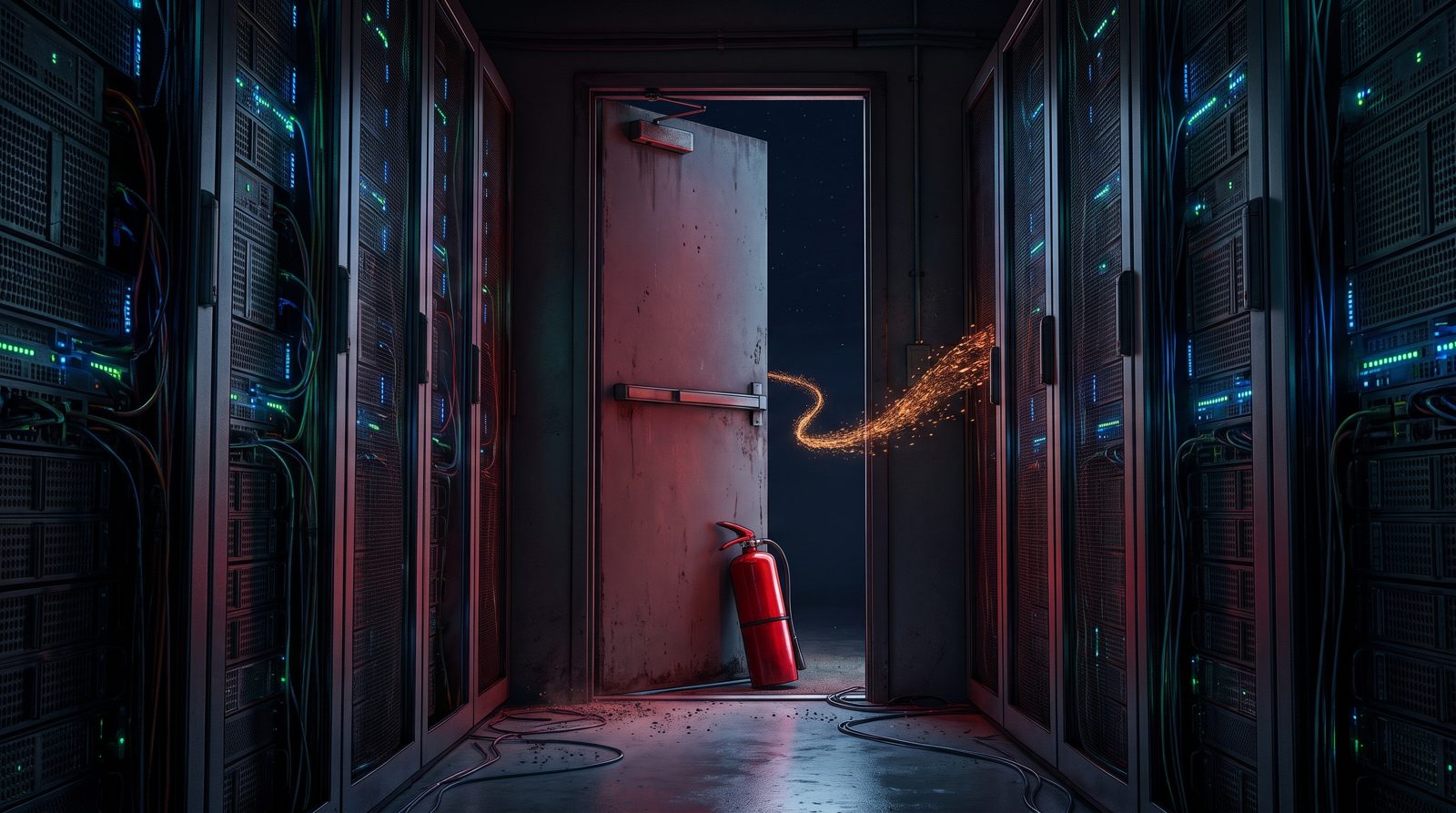
Here is a way to hold the whole story in one picture. Picture a hospital research wing whose front entrance has a badge reader, and whose loading dock has a service door that staff prop open with a fire extinguisher because the badge reader on it is annoying and, after all, only staff ever come round the back. Nobody decided the building should be open to the public. It just is, from the dock side, every day, until somebody notices. MONAI Label's default was a propped service door: sensible for a researcher running it on a laptop or a closed lab network, dangerous the moment the server could be reached from anywhere else.
The comparison is useful, but it undersells one thing. A propped door in a real building is at least visible to a security guard walking past. A server listening on an open port with authentication off looks, from the inside, exactly like a server working normally. The research group running it had no reason to see anything wrong until someone told them.
The turn: the attacker's console was propped open too
So far this reads as a story about defenders leaving doors open and attackers walking through them. The detail that reorganizes it is in the first paragraph of Amazon's "Discovery" section. On September 10, Amazon Threat Intelligence found a publicly hosted Cairn instance "running without authentication." Because the operator had left it reachable, Amazon writes, "the operational history of the platform was visible to anyone on the internet, including project configurations, actor prompts, and AI output." Everything we know about the 11 minutes, the 148 actions and the 30,000 passwords comes from the attacker's own unlocked logbook.
We looked at the Cairn project to see how that happens. Cairn lives on GitHub under the account oritera, where on November 22 it showed about 5,600 stars and more than 1,200 forks under an AGPL license, with a README describing it as "a general-purpose AI state-space search engine, validated first on autonomous penetration testing" and supporting Claude Code, Codex and Pi as worker backends. The README is explicit that it is meant only for systems you are authorized to test. The server component is a small FastAPI application, and in the current code we read, it registers its routers with no authentication layer at all. Started by hand, it binds only to the machine itself, which is a safe default. The recommended route in the README, though, is Docker Compose, and the compose file starts the server bound to all network interfaces and publishes its port on the host. Anyone who follows the quick start on a rented server and does not add a firewall or a reverse proxy has, in effect, published the console.
We cannot say which version or setup the operator in Amazon's report used, and Amazon does not say either. But the pattern is not a one-off. Google Threat Intelligence Group's latest AI Threat Tracker, published this week with Mandiant, describes a custom framework it calls exploit_agent, which it found on "an exposed staging server" alongside victim data. Gambit Security, which Amazon credits as one of the first to document a threat group using Cairn, in a September 22 interim report on attacks against online retailers, rebuilt that campaign from the operator's staging server, which its team recovered, though the report does not say how. Three separate looks inside agentic offensive operations this autumn, and in each one the investigators' view came from the operator's own infrastructure. In two of them, the reports say plainly that it had been left exposed.
The same default that let the agents in is the default that gave them away. Convenience is not a defender's weakness or an attacker's weakness. It is everybody's.
That is the turn. The popular frame says the attackers have a new, superhuman capability and defenders must race to match it. The evidence in these reports says something less dramatic and more actionable: agent frameworks make it cheap to try every unlocked door on a list, around the clock, and both sides are leaving those doors unlocked at the same rate.
Two clocks: the attack and the fix (all dates 2026, UTC where known)
- September 8 to 10. The campaign runs. Agents go from mapping MONAI Label's API to arbitrary file write in about 11 minutes, according to Amazon.
- September 10. Amazon finds the operator's unauthenticated Cairn instance and, through it, the zero-day.
- Before October 12. Amazon's security team reports the flaw privately, first against the main MONAI repository, according to the advisory.
- October 12. A pull request titled "fix: confine datastore write paths" opens in the public MONAI Label repository.
- October 19. The fix is merged to the main branch. No release follows.
- November 18, 15:45. The GitHub advisory is published, rated critical, with no patched version listed. It says the fix "will be included in the next MONAI Label release."
- November 19. A documentation commit warns that MONAI Label "has known unpatched security issues" and should only run on a closed, trusted network.
- November 20. Amazon publishes its report. Coverage follows the same day.
- November 22, 01:27. MONAI Label 0.8.6 reaches PyPI as a security release, with a CVE ID and a fix for a second path traversal flaw in session uploads. The previous release, 0.8.5, went to PyPI on November 25, 2024.
The other clock: from a merged fix to pip install
If the agent's clock reads 11 minutes, the defender's clock reads something like 73 days from discovery to an installable fix. The gap deserves a careful account, because it is easy to tell unfairly. MONAI grew out of an April 2020 collaboration between NVIDIA and King's College London, and MONAI Label is one of its satellite projects: a specialist tool with a few hundred forks and fewer than a thousand stars on GitHub. Nobody in this story was negligent in the way a headline would like.
The public record still shows exactly where the time went. The pull request that fixed the bug, opened on October 12, carries a long section titled "Pre-existing CI failures fixed in this PR." Its author wrote that continuous integration on the main branch "was already red for reasons unrelated to this change," and that fixing one layer exposed more underneath: a dependency that no longer installed on Python 3.9, a library that had never been declared as a requirement so the built package could not start, a dataset download whose hash check had been broken by an upstream default change, and a frontend build for the bundled OHIF viewer that had been failing quietly while the packaging step carried on regardless. The fix itself was a few lines. Getting the project into a state where it could ship those lines took weeks.
The commits in the final days before release tell the same story from the other end. One fixed the release workflow so that it would refuse to publish a package missing its viewer or built from anything other than a release tag, and switched the PyPI publishing action off a branch that its maintainers had retired. Another found that the CI workflows had been deleting the Python interpreter they had just installed, so every job had silently fallen back to whatever Python the runner happened to carry. A third resolved open Dependabot alerts. A fourth, merged hours before the release, fixed a second path traversal flaw: the session upload endpoint unpacked uploaded tar archives without checking the names inside them. Two of these commits carry a co-author trailer crediting Claude Fable 5.2, an AI coding model, which is its own small irony: agents on one side found the hole, and an agent on the other helped dig out the release pipeline needed to close it.
None of that is exotic. It is what happens to almost any project that goes two years without cutting a release. The build rots in places nobody looks, because nobody has needed to look. The point is not that MONAI Label's maintainers were slow. The point is that the speed of a fix is set less by how quickly someone writes the patch than by whether the path from a merged commit to a running server is still in working order on the day it is needed.
Why a public fix is also a map
The gap between October 19 and November 22 matters for a reason that Google's report makes uncomfortably concrete. A fix merged into a public repository is visible to everyone. Its title, in this case, described the bug class in five words. Its diff showed which functions had been unsafe. For a month, anyone reading the commit history could see that the current release on PyPI had a critical file write flaw in two named endpoints, while users installing the software through normal channels had no patched version to install.
Google Threat Intelligence Group describes exactly the kind of tool that turns that situation into an attack. Its exploit_agent framework, the report says, is set up "to conduct continuous differential analysis of popular web application software. It compares code before and after patch announcements, analyzes findings to identify potential vulnerabilities, drafts exploits, and automatically executes them without human intervention." The report calls it the first time GTIG had seen actors fully automate vulnerability discovery and exploitation without a human in the loop. It gives no success rate, and a write-up by Hackread notes that the report does not confirm every generated exploit worked.
The same report offers two recent examples of how short that window has become for human researchers using language models, never mind agents. After PaperCut disclosed vulnerabilities in late August, GTIG writes, Huntress and other researchers generated working exploits within a day. When PHP shipped security fixes on October 21, early patched code had already been published, which let researchers and attackers compare versions, and in the following days hundreds of claimed proof-of-concept exploits appeared that did not actually work, likely generated with the help of language models, according to GTIG.
Google's report also contains the most-quoted statistic of the week, and it deserves its caveats. According to GTIG, zero-day exploits rose from a 2025 average of 8 a month to 11 a month in 2026, then spiked to 22 in August, while overall disclosures and exploits nearly doubled between January and August. Those are counts of what GTIG observed and classified, not a census, and a single month's spike can reflect one prolific actor or one batch of disclosures. They support a modest claim, that exploitation is getting cheaper and more frequent, better than the dramatic one, that agents have broken patching. Officials in Washington reached for a version of the dramatic claim this month when they blamed a run of outages on an AI-era patching rush, and the stated causes of those outages mostly had little to do with patches.
Put the two clocks next to each other and the lesson for builders is not "patch faster," which everyone already knows. It is that the riskiest interval is often after the fix exists and before it ships. In that interval, the vulnerability is effectively public, and the patch is not available. An agent that diffs commits works best exactly there.
Same week, same trick: Python's startup door
There is a smaller technical thread in Amazon's report that connects it to another incident from this week. The agents got from a file write to code execution by planting sitecustomize.py, which Python's standard site module imports automatically whenever the interpreter starts. Three days before Amazon's post, on November 17, someone published two malicious versions of agent-framework, Microsoft's Python package for building AI agents, to PyPI.
According to the GitHub advisory for that compromise, GHSA-764m-3ppc-5m73, version 1.26.1 went up at 20:35 UTC and 1.26.2 at 21:08 UTC, and both have since been removed. Each added a .pth file, a path configuration file that the same site module processes at every interpreter start. A line in a .pth file that begins with import is executed, so the stealer ran as soon as the package was installed, whether or not anything ever imported the framework. It collected environment variables with names like TOKEN, SECRET, AZURE, AWS and GITHUB, credential files for tools such as the Azure CLI, npm, Git, Docker and Hugging Face, and tokens from the cloud metadata service. Version 1.26.2 added GitHub Actions OIDC tokens to the list. Help Net Security reported that 1.26.2 was uploaded after PyPI had already quarantined 1.26.1, which suggests the attacker still had publishing access. How they got it has not been explained publicly.
The exfiltration detail is the one webhook readers will wince at. The advisory says the stolen data was compressed, encoded and posted to a URL on webhook.site, the public request-inspection service many developers use to look at test payloads. A debugging tool on half the internet's allowlists became a drop box.
Two attacks, one week, the same underlying move: Python will run code from certain files at startup without anyone asking it to, and both the agents and the package thief used that to turn a foothold into execution. If your agents run Python, and most do, the directories that hold site-packages and the interpreter's startup files are as sensitive as any credentials file. We made a similar point about CI runners in our look at the wfx CI secret stealer, which also went after OIDC tokens because they outlive the rotation of ordinary secrets.
Your webhook receiver has an image parameter too
It would be comforting to file all of this under "medical imaging research tools" and move on. The shape of the MONAI Label bug, though, is one that integration code reproduces constantly. A webhook arrives with an attachment and a filename. An event carries an ID, and the handler writes the payload to a file named after it for later replay. A no-code platform's custom code step saves an upload under a name taken from the form. An agent tool accepts a path argument from the model and writes a report there. In each case, a string chosen by someone outside your system becomes a location on your disk, and the only thing standing between that string and your application's startup files is whether somebody remembered to resolve the path and check where it lands.
The usual defense in webhook design is authentication of the sender, through a signature check of the kind we compared in HMAC versus JWT for webhooks. That is necessary and not sufficient. MONAI Label's advisory points out that even with authentication enabled, an ordinary annotator could exploit the flaw. A valid signature tells you who sent the payload. It tells you nothing about whether the filename inside it is safe to use. The same goes for an idempotent webhook handler that keys its deduplication store on an event ID: if that ID ever becomes part of a path, it needs the same confinement check as any upload name.
Agents add a twist. A tool that writes files on behalf of a language model takes its arguments from model output, and model output can be steered by whatever the model last read: an email, an error message, a web page. We wrote about how event-driven AI agents wire tools to incoming events. Every one of those tools that touches the filesystem is, from a security standpoint, an upload endpoint with a caller-controlled name.
The defaults that keep turning up
Step back and this week's story lines up with a run of incidents we have covered this month, all of them about what a system does before anyone has configured it carefully. Bitrise's breach came through an internal testing bot account that had no second factor because it was only for testing. Shopify started requiring an IP allowlist for public apps because the previous default was that any caller with a token could reach the Admin API from anywhere. When GitHub added connectors to Copilot, the word "verified" described the pipe, not the permissions flowing through it. In each case the dangerous state was not a mistake someone made. It was the state the system arrived in.
Defaults are set for the first five minutes of use: the researcher evaluating a tool on a laptop, the developer trying a framework's quick start, the team wiring up a test bot. They are almost never revisited for the next five years of use, when the same tool runs on a server reachable from a campus network or the open internet. Agent frameworks change the economics of that gap. A human attacker with a list of a thousand servers has to choose which ones are worth an afternoon. An agent with a list of a thousand servers can spend sixteen hours on each, as Amazon's Redis example shows, for the price of tokens. Gambit's report put a number on that price for its retail campaign: the operator's own review averaged $25.46 per completed scan, and recorded spending was about $7,000 over four weeks, against at least 27 companies compromised and more than 600,000 unexpired card records taken from two of them. Those figures are Gambit's interim estimates, and the firm says they may contain errors.
That price is the real change. Not that agents can find bugs a skilled human could not, because nothing in Amazon's report suggests a path traversal in an unauthenticated upload endpoint was beyond a skilled human. The change is that checking every propped door on a long list has become nearly free, and the doors are still propped.
What we know, and what we don't
Some limits are worth stating flatly. Everything about the campaign itself, from the 11 minutes to the 148 actions, comes from one source, Amazon's analysis of the operator's exposed instance, and no outside party has published an independent reproduction. Amazon rates its zero-day judgment as high confidence, based on the absence of any prior fix, issue, advisory or database entry, and its attribution to a China-nexus actor as moderate confidence, based on the language of the prompts, timestamps and target choice. Moderate confidence is a real hedge, and it does not say anything about state direction.
We do not know how many MONAI Label servers are reachable from the internet or from large shared networks, how many were compromised before November 22, or whether anyone used the public fix in October to build an exploit. Amazon says the affected organizations were not AWS customers and were notified through a government partner. We do not know which version of Cairn the operator ran, or whether the console was exposed through the Docker Compose route we describe or some other setup. And we do not know whether the operator in Amazon's report has any connection to the actors in the Gambit or Google reports; the shared thread is a tool and a habit, not an identity.
Finally, our timeline uses the dates GitHub and PyPI record, which are precise. The date Amazon first reported the bug privately is not public; the advisory says only that it was originally reported against the main MONAI repository.
Six checks for the doors your integrations leave open
- Inventory every service that is listening, and how it authenticates by default. Include the ones that "only run internally": labeling tools, vector databases, agent consoles, workflow engines, dashboards. For each, write down whether authentication is on, and whether it was on before you touched it. If the answer is "off by default," treat that service as public until you can prove it is not reachable.
- Check what your container setup actually publishes. A quick-start compose file that publishes a port on the host exposes that service on every interface the host has, and Docker's own documentation warns that published ports can bypass host firewall rules. Bind consoles to the loopback interface or put them behind a reverse proxy with real authentication.
- Confine every path built from outside input. Webhook attachment names, event IDs, session IDs, agent tool arguments: resolve the final path, check that it is inside the directory you intended, and reject anything else. MONAI Label's fix does exactly this, and also reduces IDs to a bare name and rejects empty or dot-prefixed values. Unpack archives with a library that checks member names.
- Run services as a user that cannot write to its own code. The agents reached root because the process that accepted the upload could write to Python's startup path and ran with root privileges. A service account with write access limited to its data directory turns an arbitrary file write into a much smaller problem. Watch
sitecustomize.pyand new.pthfiles in your interpreter directories as integrity signals. - Measure the distance from merged fix to deployed fix, for your dependencies and your own code. If a critical dependency has not cut a release in a year, find out whether its release pipeline still works before you need it to. For your own services, a release gate that runs on every merge keeps the path from rotting. Track security fixes merged upstream but not yet released, and apply them from source or mitigate when the window stays open.
- Restrict outbound traffic as carefully as inbound. The agent-framework stealer posted to a public webhook-inspection service. A build runner or agent host that can only reach the hosts it needs would have stopped that request. If you use public request bins for debugging, keep them out of production allowlists, and route failed outbound events to a dead letter queue you control rather than to a third party's inbox.
The propped door, at three in the morning
The instinct after a report like Amazon's is to imagine the attacker as a new kind of genius and to wonder how anyone keeps up. The record in this case points the other way. The agents spent sixteen hours failing against a configuration whose known tricks had been closed, six hours failing against passwords that held, and eleven minutes succeeding against an upload endpoint that, as shipped, asks nobody for anything. Their operator, meanwhile, was undone by the same habit: a console left open on the internet, logbook and all.
The useful change of stance is from thinking about attackers as clever to thinking about them as thorough. A clever attacker picks the one door worth the effort. A thorough one, which is what an agent framework makes of even a mediocre operator, tries every door on the list, all night, every night, and never gets bored. Against that kind of visitor, the questions that matter are not about speed of response. They are about which doors ship propped open, who is responsible for closing them, and how long it takes for a fix to travel from a merged commit to the machine that needs it. Those are questions about your defaults and your release pipeline, and you can answer both today.
FAQ
What is MONAI Label, and who needs to update?
MONAI Label is an open-source server, part of the MONAI medical imaging AI project that NVIDIA and King's College London launched in 2020, used to label medical images and train models interactively. Every version up to and including 0.8.5 is affected by the datastore upload flaw (GHSA-qc22-rmgc-vg94, CVE-2026-133968) and a second flaw in session uploads. Version 0.8.6, published to PyPI on November 22, 2026, fixes both. The maintainers advise enabling authentication, keeping the server off untrusted networks, and checking any server that was reachable for unexpected file changes.
What is Cairn?
Cairn is an open-source framework, published on GitHub in 2026, that coordinates multiple AI agents toward a goal stated in plain language, and it was first validated on penetration testing. Its README says it is meant only for authorized testing. Amazon, Google and Gambit Security have each reported threat actors using it in real intrusions this year.
Did the AI agents do something a human hacker could not?
Nothing in Amazon's report suggests so. Path traversal in an unauthenticated upload endpoint is a well-known class of flaw. What changed is cost and persistence: the agents found it in about 11 minutes without a human choosing each step, and spent many hours on other targets at little cost to the operator.
Does this affect webhook receivers and automation platforms?
Not directly, since the flaw was specific to MONAI Label. But the pattern applies to any service that turns caller-supplied names or IDs into file paths, including webhook handlers that save attachments or payloads, custom code steps in no-code tools, and agent tools that write files. Authenticating the sender does not make the contents safe to use as a path.