TL;DR
- On October 20, one zone of Google Cloud's London region, europe-west2-b, lost power for hours after a utility cable failed and the backup generators never received a start signal. Revolut's cards and app stopped working for customers across Europe.
- Google's revised incident report, posted November 4 and picked apart in the trade press this week, says the damage did not stay in one zone. Demand surged into the two neighboring zones, cross-zone control-plane calls timed out, and "some of these failover attempts were unsuccessful due to capacity constraints."
- Most coverage reads this as a story about generators. For anyone running webhooks, APIs or automation on a cloud region, the more useful lesson is that "multi-zone" describes where your code can run, not whether there will be room for it when everyone moves at once.
On Wednesday, October 14, engineers at the data center that hosts Google Cloud's europe-west2-b zone in London opened the circuit breaker on one of the site's two utility feeds. A quarterly generator load test had turned up problems, and the breaker was opened, in Google's words, "to allow for corrective repairs." For the next six days the whole building ran on the other feed.
Shortly before 06:00 UTC on Tuesday, October 20, an external underground cable feeding that remaining line broke. This is the moment a data center is built for. The batteries in the uninterruptible power supplies picked up the load, and the generator plant was supposed to start and take over before they ran down. It never got the order. According to Google's own account, the sensors that tell the generator controller whether the utility is healthy had been wired on the utility side of the breaker that was open for repairs. The controller kept seeing a live line, concluded that "a healthy utility source was available," and issued no start command. By Google's timeline, the batteries ran out about seven minutes after the cable failed. Zone b went dark.
Within an hour, Revolut customers across Europe were reporting failed card payments, failed logins and failed transfers. Outage trackers lit up for Royal Mail, DPD and Rightmove too, and The Register listed Lloyds and HSBC among the services users were reporting trouble with, though neither bank confirmed a link to Google. Google's first update, more than two hours in, said there was no workaround "for now." Later that morning its status page offered a piece of advice: if feasible, impacted customers "may try to migrate their workload impacted to another available location."
That sentence is the one worth slowing down for. Google's revised incident report, posted on November 4 and dissected by The Stack's Edward Targett on November 10, explains what happened to the customers who tried. Some of them could not get out. The report says plainly that "some of these failover attempts were unsuccessful due to capacity constraints," and adds that replicating the underlying storage was difficult too. It also says the outage spread well beyond the zone that lost power, into the two zones that were supposed to absorb it.
Most of the coverage has treated this as a power story: a wiring flaw, a misconfigured controller, a cable in the wrong place at the wrong time. All of that is true, and Google says the controller has been reprogrammed and validated. But for the people who build webhook receivers, API gateways and automation pipelines on top of a cloud region, the power story is the least useful part of the report. The useful part is what happened in the hours after the lights went out, when a great many systems, all designed to survive the loss of one zone, tried to survive it at the same moment. This piece walks through that part, connects it to three other outages that failed the same way, and ends with a set of questions worth asking about your own failover before the next one.
What actually failed inside the building
It helps to be precise about the electrical failure first, because it explains why the rest of the region was caught off guard.
Google describes the site as having "a 2N utility power architecture," meaning two complete, independent power paths for every critical load, backed by a central high-voltage generator bank run by a dual-redundant programmable logic controller. On paper, that is a building that can lose one utility feed and not notice, and lose both and still run on generators. In practice, on October 20, one feed had been deliberately opened for six days, so the building was running on a single path. When that path failed, the only remaining protection was the generator plant, and the generator plant depended on a sensor reading that was wrong.
The Register's Simon Sharwood summarized Google's explanation on November 5: a "voltage-sensing design flaw and PLC misconfiguration prevented the facility's generator plant from receiving an automatic start signal." Standby utility power was restored at about 06:54 UTC, and power returned to the data halls at about 07:20 UTC, according to Google's timeline. Then came the slow part. Engineers checked storage integrity before bringing compute back, because restarting thousands of servers on top of disks that lost power mid-write is how an outage turns into data loss. Zonal virtual machines and disks came back between roughly 11:00 and 11:30 UTC. New VM creation resumed at 11:46 UTC. By 12:08 UTC, Google says, more than 99% of VMs were healthy.
Google's action list is long and specific. The controller has been reprogrammed and validated. Similar sites are under review, with global validation estimated for mid-November and broader prevention controls estimated for December 18. Maintenance at comparable facilities was frozen as of October 30. And the electrical repair is not quite finished: the 4 November report estimates that the broken utility feed would be restored around November 13 and the transfer back to primary utility power around November 17. In other words, the building side of this incident is still being closed out this week.
The generator problem had a clear owner and a clear fix. The next problem had neither.
How one dark zone degraded a whole region
A cloud region like europe-west2 is made of three zones, a, b and c. Each zone is meant to be an independent failure domain, with its own power, cooling and networking, so that losing one leaves the other two running. Google's regional services, the ones that promise to survive a zone failure, are designed around exactly that assumption. The report says so directly, then explains that "a set of unexpected failures" caused impact "outside of the zonal failure domain."
It names two primary causes. The first is "instantaneous demand surges on neighboring zones (a and c)." The second is "control-plane dependencies across zonal boundaries." Both deserve a closer look, because neither is specific to Google.
The demand surge is the simpler of the two. When zone b disappeared, everything that could move out of it tried to move at once: redirected queries, database failovers, batch jobs and customers' own workloads. The report describes this rush as having "saturated available compute slots and processing capacity in other availability zones." That saturation produced admission queues, slower database failovers and intermittent 500 and 503 errors across the region. The two surviving zones had not failed. They were simply full.
The control-plane problem is subtler. The data plane of a cloud service is the part that does the work: serving requests, storing bytes, running containers. The control plane is the part that manages that work: creating resources, scheduling jobs, handing out metadata. Google's report says cross-zone remote procedure calls from regional control planes "encountered timeouts, causing initial job submission stalls and API latency spikes." A service whose data plane survived in zones a and c could still stall because its management layer was waiting on something in zone b. The 27 October version of the report put it in one honest line: "This was not a full regional control-plane outage, but certainly a degraded state."
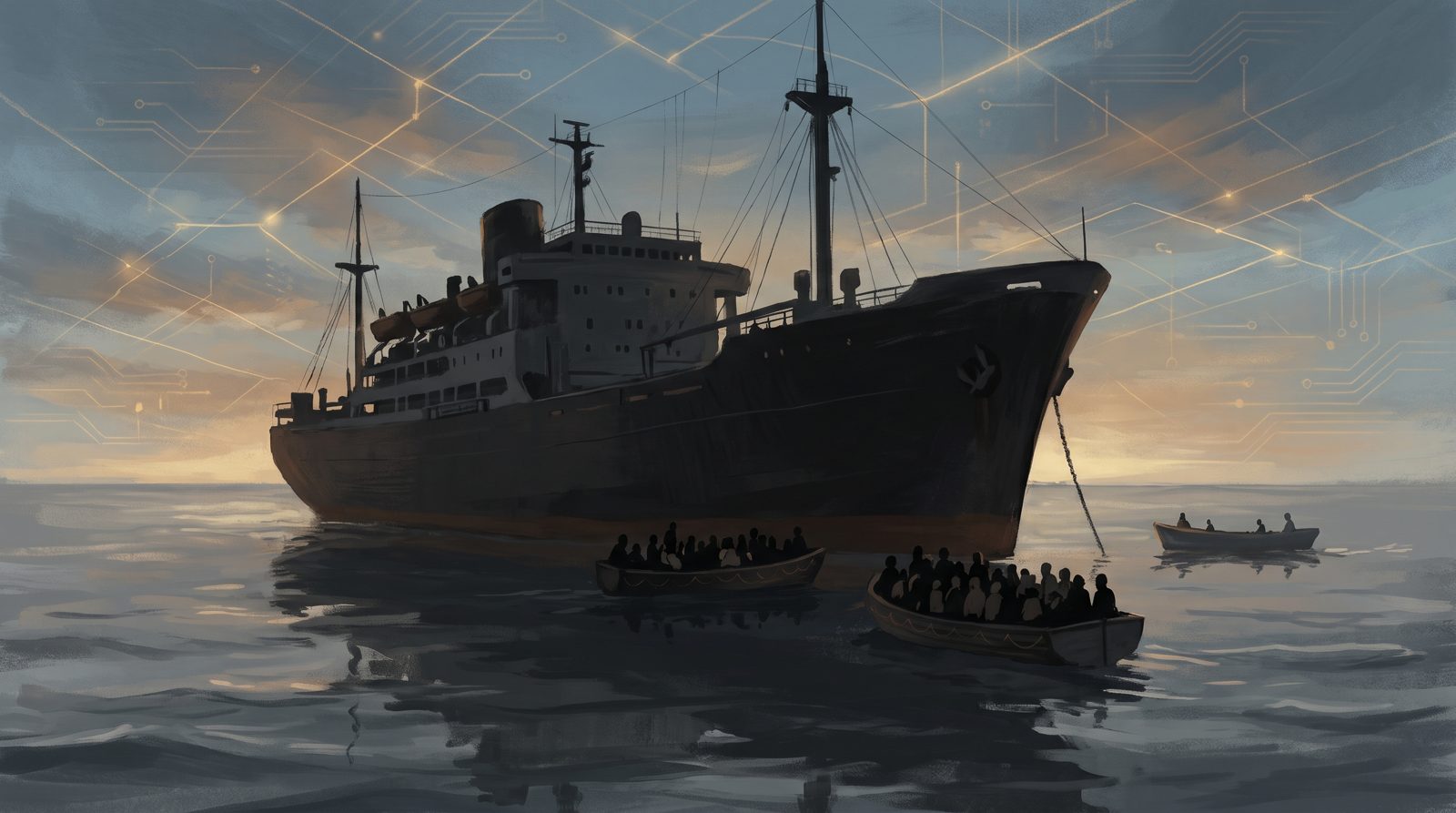
Here is a picture that helps. A three-zone region is a ship with three lifeboats, and the safety plan says any two of them can carry everyone if the third one sinks. The plan is correct as far as it goes. What it does not say is whether there are seats in the two remaining boats for every passenger at the same time, or whether the boats can be lowered while the crew who operate the davits are standing on the deck that is flooding. The lifeboats exist. Whether there is a seat for you is a separate question, and nobody asks it until the drill is real.
The analogy flatters the cloud in one way worth naming. On a ship, every passenger knows there is a limited number of seats. In a cloud region, the capacity in neighboring zones is invisible to customers until they ask for it, and they tend to ask for it at exactly the moment everyone else does.
Three failures inside the failover
Google's product-by-product breakdown reads like a catalog of the different ways a design can survive a zone loss on paper and fail it in practice. Three entries stand out for anyone who runs APIs and event pipelines.
Apigee X, Google's API management product, returned elevated HTTP 5xx errors for 7 hours and 19 minutes. Apigee X keeps three replicas of its datastore, one per zone, precisely so it can lose a zone. But a scheduling misconfiguration had placed two of the three replicas in zone b. When b went dark, the datastore lost quorum, and the runtime failed requests rather than failing over. Google says it has since audited the fleet, rebalanced unevenly placed instances, added alerts for replica drift, and will now strictly require three replicas in three different zones. The design was right. The placement was not, and nothing was watching the placement.
BigQuery saw job latency rise and queries queue heavily for about five hours. The cause was an autoscaling dependency in a critical data plane job, which could not scale up during the failover. The system was designed to absorb the loss of a zone by growing in the remaining zones, and the growth itself depended on machinery that was degraded. Google says it has removed the dependency on autoscaling from job provisioning. A smaller group of customers outside the affected zone saw about 1% elevated error rates on Job API calls because of concurrency throttling that the report calls overly broad.
Cloud SQL regional high-availability instances failed over automatically, mostly. The report says the failover "was complete for regional instances that did not have Regional Persistent Disk failures," and that a majority of the remaining instances recovered within about two hours. The failure sequence was unusual enough that Google says it is now investigating new signals so Regional Persistent Disk can tell this pattern apart from an ordinary zonal outage.
Compute Engine, the foundation under much of the rest, carries the sentence that matters most. The report notes that Compute Engine's zonal resources expect customers to build their own cross-zone failover and recovery. Some customers had done exactly that. And some of their failover attempts, Google says, failed on capacity.
Every one of these systems was built to survive the loss of a zone. Each one depended on something that was only true when no zone was lost.
Pocket glossary: reading a cloud incident report
- Zone. An isolated location inside a region, with its own power, cooling and network. Meant to fail independently of its neighbors.
- Region. A group of zones in one metro area (europe-west2 is London). "Regional" services promise to survive the loss of one zone.
- Data plane. The part of a service that does the work your users see: answering requests, storing data, delivering messages.
- Control plane. The part that creates, changes and schedules resources. It is often what breaks during recovery, because recovery means creating things.
- Quorum. The minimum number of replicas that must agree before a datastore accepts reads or writes. Put two of three replicas in one zone and that zone can take the quorum with it.
- Capacity reservation. Compute you pay for in advance in a specific zone, whether or not you use it, so it is there when you need it.
- Static stability. Amazon's term for systems that keep working during a failure without having to create or change anything, usually because the spare capacity already exists.
- Herd effect. Many clients retrying or restarting at once and overloading the thing they all depend on.
The turn: failover is a purchase, not a switch
The common mental model of multi-zone resilience is a switch. Something fails, traffic flips to the healthy side, and the system carries on. That model is accurate for the parts of a system that are already running in the healthy zones and already sized to carry the extra load. It is wrong for everything else.
For everything else, failover is a purchase. A replacement VM, a new container, a promoted database replica or a scaled-up job pool is a request for capacity, made to the provider's control plane, at a moment when that control plane is degraded and every other customer in the region is placing the same order. The October 20 report is, among other things, a record of what happens when that purchase is attempted in a crowd. Some orders were filled. Some were not.
None of this is hidden knowledge. Amazon has been explicit about it for years. Its whitepaper on fault isolation boundaries describes the scenario almost exactly: when a zone loses power, "for a service deployed across three Availability Zones, losing a third of the fleet's capacity can lead to overload." Letting auto scaling replace the lost instances, the paper says, "creates a dependency on the Amazon EC2 control plane to launch new instances." Amazon's own answer is to pre-provision instances in the remaining zones "to absorb the load." It calls the property static stability, and it describes the principle in one sentence: systems "that are preconfigured to tolerate failures, rather than dynamically responding to them, are more reliable because their behavior doesn't change during failures."
Google sells the same insurance. Compute Engine reservations, according to Google's documentation, provide "a high level of assurance of capacity" in a specified zone, and the documentation lists disaster recovery as a use case. The catch is in the next line: a reservation "incurs charges for its reserved resources for as long as the reservation exists, regardless of whether or not its resources are being used." That is the honest price of a lifeboat seat. You pay for it on every calm day, so that it is empty on the one day you need it.
Most teams do not buy it, for understandable reasons. Paying for idle capacity in extra zones adds a standing cost to a service that may never need it. So the industry quietly runs on a shared assumption: that when a zone fails, the neighbors will have room, and the control plane will be healthy enough to hand it out. October 20 tested that assumption in public.
Multi-zone is a statement about where your code may run. It says nothing about whether there will be room for it when everyone moves at once.
Same city, same shape, two years apart
If October 20 were a one-off, the generator story would be the whole story. It is not, and the pattern is easiest to see in Google's own archive.
On August 12, 2024, a substation switchgear failure took out both the primary and backup power feeds at a Google point of presence in London. About a third of the first-layer Google Front Ends in europe-west2 went offline. Traffic was redirected to the nearest healthy front ends, as designed. Then, in the words of Google's incident report, "overloading in the automatically selected replacement route GFEs extended the duration of the incident," and manual adjustments were needed to deal with the overload. A different building, a different layer of the stack, the same city, the same shape: the backup path worked and then drowned under the traffic it was asked to carry.
On June 12, 2025, a malformed policy change crashed Google's Service Control system around the world. Recovery in us-central1 lagged behind the other regions; Google's report says it took up to about 2 hours and 40 minutes to fully resolve there. The reason, according to Google's report, was that the restarting tasks "created a herd effect on the underlying infrastructure it depends on," a Spanner table, because "Service Control did not have the appropriate randomized exponential backoff implemented to avoid this." The recovery itself was the load that slowed the recovery.
On October 19 and 20, 2025, Amazon's us-east-1 region suffered a long outage that started with an empty DNS record for DynamoDB's regional endpoint, produced by a race condition in DNS automation. DynamoDB came back within hours, but EC2's instance-launch machinery did not. Amazon's post-event summary says the system that manages leases on physical hosts "had entered a state of congestive collapse," engineers had to throttle incoming work and restart hosts selectively, and new launches failed with "insufficient capacity" errors until the leases were rebuilt. The capacity existed. The machinery to hand it out was buried under its own backlog.
And in April 2023, a water leak and fire at a Paris facility hosting Google's europe-west9 region led to what Google's status page called a multi-cluster failure and the shutdown of multiple zones. Zones that were meant to be independent shared enough physical infrastructure to fail together.
Read in order, these incidents describe one recurring blind spot. Cloud architecture is very good at surviving the first failure, the one the diagrams are drawn for. It is much less tested on the second-order failure: the surge of recovery traffic, retries and capacity requests that follows. Google's own remediation list points at the same gap. It says it is expanding its regular disaster-recovery testing "for full cluster power-loss scenarios," and expanding platform-wide testing for infrastructure-level events. That reads as a quiet acknowledgment that this scenario needed more rehearsal than it was getting.
Why this is a webhook story
It is tempting to read all of this as a problem for banks and large platforms. It lands just as hard on small teams running event-driven systems, for a reason specific to webhooks: when your receiver goes down, the events do not stop. They queue up somewhere else, on someone else's schedule, and then they come back.
Stripe's documentation spells out its side of that arrangement. In live mode, Stripe "attempts to deliver events to your destination for up to three days with an exponential back off." That is a generous policy, and it is the reason most Stripe integrations eventually catch up after an outage. It also means that a receiver that was unreachable for eight hours does not come back to a quiet queue. It comes back to every retry that was scheduled while it was down, landing alongside live traffic, on infrastructure that may still be recovering. Stripe's own guidance warns that a large spike in deliveries "might overwhelm your endpoint hosts" and recommends processing events through an asynchronous queue. If your recovery plan for the Stripe-to-Slack pipeline assumes a quiet restart, the retry schedule says otherwise.
GitHub sits at the other extreme. Its documentation says plainly that "GitHub does not automatically redeliver failed webhook deliveries." Failed deliveries can be redelivered manually, but only within the past three days. A receiver that was down during a regional outage simply misses those events unless someone goes back for them, and a team that only notices a week later has nothing left to redeliver. For integrations like that, a reconciliation poll alongside the event stream is not a nice-to-have. It is the only record that you missed something.
Both behaviors collide with the capacity problem in the same place. The moment your receiver tries to fail over into another zone is also the moment it most needs to scale, because the backlog is about to arrive. A receiver that depends on autoscaling to absorb the post-outage wave is making the same bet BigQuery's job pool made on October 20. And if your API gateway sits in front of that receiver, the Apigee replica story is a reminder that "three zones" is a property of the deployment, not the brochure.
The defenses here are not new, and that is the point. Idempotent webhook handlers make a flood of retries safe to process. A dead letter queue with sensible retry backoff stops a recovering system from hammering its own dependencies, which is precisely the randomized backoff Google said Service Control lacked in 2025. Accepting events fast and processing them from a durable queue, the core of resilient webhook design, turns a sudden wave into a backlog you can drain at your own pace. A multi-step automation that died halfway through during the outage needs a way to finish or undo its half-done work, which is what the saga pattern for webhooks exists to handle. What October 20 adds is the reminder that each of these patterns needs somewhere to run while the region is degraded.
An outage does not end when the provider says it has ended. For a webhook receiver, that is when the retries arrive.
The numbers, and why they disagree
The figures around this incident are real, but they come from different clocks and different definitions, and they are easy to mix up.
Duration first. Google's incident report gives an impact window of 6 hours and 8 minutes, from 06:00 to 12:08 UTC, which is roughly when more than 99% of VMs were back. FinanceFeeds and WorldHab both put the disruption at 7 hours and 52 minutes, a figure that runs to the closure of the incident record, after a tail of isolated workloads had recovered. Apigee X's error window alone ran 7 hours and 19 minutes. All three numbers are defensible. They measure different things: the core outage, the incident record, and one product's experience of it. Your own outage was whichever of those your stack depended on, plus however long your own recovery took.
Then scope. UptimeRobot, which tracked Google's status page through the day, counted 38 products on Google's affected list by midday. The list in the final report is longer, because later revisions added services that were affected through cross-zone effects. Neither count tells you how many customers were hurt, and Google has not published a customer figure.
Then attribution. Revolut's disruption was tied to the Google outage by a source speaking to Reuters and by The Stack's reporting, and Revolut told customers their money and data were safe. Lloyds, Halifax and HSBC customers reported problems on the same morning, but according to the trade reporting we reviewed, neither Lloyds Banking Group nor HSBC confirmed that Google was the cause. A coincidence of timing on an outage tracker is not a dependency map.
The number that matters most is one nobody has published: how many customers tried to fail over and could not.
The regulator's first real test
There is a reason this outage drew more official attention than most. In July 2026, HM Treasury brought the first four cloud providers under the UK's critical third parties regime, a framework that lets the Bank of England, the Prudential Regulation Authority and the Financial Conduct Authority oversee technology suppliers whose failure could ripple through the financial system. According to trade reporting by FinanceFeeds and WorldHab, Google Cloud EMEA Limited was one of the four, alongside Amazon Web Services, Microsoft and Oracle. The Bank of England's own page on the regime says designated firms must "maintain open, timely communication with regulators and the firms that rely on them," particularly during major incidents.
Just over three months later, one of those firms took down a bank's card payments for most of a working day. The FCA said it was engaging with Google and the affected firms. Dame Meg Hillier, chair of the House of Commons Treasury Committee, wrote to the Governor of the Bank of England and the chief executive of the FCA asking how they had responded, what they would do next and what harm customers had suffered, according to reports by WorldHab and FinanceFeeds. WorldHab reported that an initial reply was requested by early November.
It is worth noticing what this oversight can and cannot see. A regulator can ask whether Google's generators work, whether its controller logic is validated, and how quickly it communicates. Those are the questions the incident report answers best. It is much harder for a regulator to ask the question this piece keeps returning to: whether the banks that depend on europe-west2 had paid for enough headroom in the other two zones to actually use them. That is not Google's failure domain. It belongs to every customer that drew a three-zone diagram and stopped there.
What we know, and what we don't
Google's report is detailed and, by the standards of cloud incident reports, candid. It names the wiring flaw, the replica misplacement, the autoscaling dependency and the capacity constraints. That candor deserves credit, and everything in the mechanism sections above comes from it directly.
There are also clear limits. Google does not say how many customers attempted cross-zone failover, how many failed, or for how long. It does not say whether customers who held capacity reservations in zones a and c were able to use them throughout, which is the single most useful data point for anyone deciding whether reservations are worth the money. Revolut has not published its own post-incident analysis, so we do not know whether its architecture was single-zone, multi-zone without reserved capacity, or something else. And the remediation dates in Google's report are estimates, several of which moved between the 27 October and 4 November versions.
We also cannot say whether the capacity constraint was a shortage of physical machines in zones a and c or a control plane too degraded to allocate the machines that existed. Amazon's 2025 outage was clearly the second kind. Google's wording, which pairs capacity constraints with difficulty replicating storage, leaves room for both.
Five questions to ask of your own failover
None of the following requires a bank's budget. Each is a question that October 20 answered the hard way for somebody.
- Is your failover a switch or a purchase? The useful exercise is a list of everything that has to be created, scaled or promoted when a zone disappears. Every item on it is a capacity request made at the worst possible moment. Anything that is already running and already sized in the other zones is a switch. Everything else is a bet on the neighbors having room.
- Where do your replicas actually live today? Apigee's design called for three zones and its scheduler delivered two in one place. A quick audit of where your database replicas, queue partitions and webhook receiver instances are really placed tends to find drift that nobody chose on purpose.
- What happens in the hour after recovery? Sender retry policies differ widely. Stripe keeps retrying for up to three days with backoff, so your receiver comes back to a wave. GitHub does not retry at all, so your receiver comes back to a silence that only looks like calm. Idempotency, a durable queue in front of processing, and a reconciliation job cover both cases.
- Does your recovery depend on the control plane? If restoring service means calling cloud APIs to launch, resize or reconfigure, recovery shares a fate with the provider's management layer, which is exactly what degraded across europe-west2. Durable workflow engines such as those compared in our look at Inngest and Temporal help on the processing side, and the case for Temporal on a small team is stronger than it used to be, but every such engine still needs workers somewhere to run.
- Have you priced the empty seat? Pre-provisioned capacity or zonal reservations cost money every day. Running without them also has a price, paid in hours of downtime on one bad morning. Neither choice is wrong. Making it without writing the number down is.
Count the seats
The generator story will get the follow-up headlines, because it has a villain, a wiring diagram and a date for the fix. It is also the part of October 20 that most readers can do nothing about. The part that belongs to everyone who builds on a cloud region is quieter. A zone failed, exactly as zones are expected to fail now and then, and the thing that turned a zone failure into a regional bad day was the assumption, shared by Google's own services and many of its customers, that the neighbors would have room.
The lifeboats were there. Some of them were full before the passengers from zone b reached the deck. For a webhook receiver, an API gateway or an automation pipeline, the useful question was never whether the architecture diagram shows three zones. It is how many seats are actually reserved in the other two, what it costs to keep them empty, and who checked last. The cloud did not promise you a seat. It promised you a boat, and those are different things.
More coverage of platform failures and their fallout lives in our platforms section, and patterns for building receivers that survive them are collected under webhooks.
FAQ
What caused the Google Cloud London outage on October 20, 2026?
One of the facility's two utility feeds had been switched off for repairs since October 14. When an underground cable broke on the remaining feed, the backup generators did not start, because the sensors that tell the generator controller whether utility power is present were wired on the wrong side of the open breaker. The battery systems ran out after a few minutes and zone europe-west2-b lost power.
If only one zone lost power, why were other zones affected?
Google's report gives two main reasons: a sudden surge of demand into zones a and c as workloads, queries and databases failed over, and control-plane calls that crossed zone boundaries and timed out. Some services also had internal flaws, such as Apigee X placing two of its three datastore replicas in the failed zone.
Does running in multiple zones protect my webhooks from this kind of outage?
Only if the capacity in the other zones already exists and does not depend on scaling up during the incident. Instances already running in healthy zones, sized to carry the full load, keep working. Anything that must be launched or scaled after the failure competes with every other customer for capacity at the same moment.
Will webhook providers resend events I missed during an outage?
It depends on the provider. Stripe retries live-mode deliveries for up to three days with exponential backoff. GitHub does not retry failed deliveries automatically, and manual redelivery is limited to the past three days. Idempotent handlers and a periodic reconciliation check cover both behaviors.